Early morning on the first day
Golyadkin Awakens
Yakov Petrovich Goliazhkin awoke in a modest room in St. [Petersburg](entity:location-recall-location-petersburg-2b56d8d0c312), checked his reflection, and was relieved that his appearance was without flaw. He counted the 750 rubles he had been guarding, noting any movement in the yard; Peterushka was nowhere
Morning on the first day
The Hired Carriage
[Petrushka](entity:character-recall-character-petrushka-9509714a4ba3) returns with rented uniform and carriage. Golyadkin puts on his best clothes and rides to Nevsky Prospekt. He is satisfied with the display, but worries about being seen in this state. Two young colleagues notice him, and then he meets his superior, Andrei Fil
Morning on the first day
The Doctor’s Advice
Golyadkin turned the carriage around to visit Dr. Krestyansky Ivanovich Rutensticht, the doctor who had treated him last week. The doctor advised him to change his lifestyle, to socialize more, and not to keep himself isolated. Golyadkin did not
Late morning on the first day
The Doctor’s Disclosures
As he was about to leave, Goliatkin told a complicated story to Krestyansky Ivanovich, involving promotions, family gatherings, and rumors about Clara Orsufiyevna, Vladimir Semenovich, and [Karolina Ivanovna](entity:character-recall-character-karolina-ivanovna-e5ece04c8c65). He presented himself as a victim of a
Late morning through midafternoon on the first day
A Morning of False Purchases
In the arcade, Golyadkin solemnly promised to buy a set of tableware, silverware, women's clothing fabric, and furniture for six rooms. He repeatedly promised to pay a deposit, yet in the end he only bought a few things such as gloves and perfume; at the same
Midafternoon on the first day
The Clerks’ Laughter
At a restaurant on Nevsky Prospekt, Goliazhkin met two young employees in the department. He tried to establish a new way of getting along with them, talking about masks, the embellishments on the social stage, and those who intrude into others' lives without invitation. The two
Late afternoon on the first day
The Dinner Refusal
Goriladkin came to the house of Orsufiy Ivanovich Berenyev. He thought he was invited to a family dinner to celebrate Clara Orsufiyevna's birthday. The servant refused to let him in, explaining that they had been ordered not to let him in
Evening on the first day
The Birthday Celebration
In the manor, the family held a grand banquet, toasts, and ball to celebrate Clara Orsufiyevna. Andre Filippovich and Vladimir Semenovich were publicly honored, and the guests also joined in the festivities, reveling joyfully
Later that evening on the first day
The Uninvited Dance
After waiting for several hours, Goliatkin quietly crossed through the back room and slipped into the living room. He congratulated Clara Orsufiyevna on her birthday, stammered a few words of good wishes, and tried to act as one of the guests, standing alone by the
Midnight on the first day
The First Double
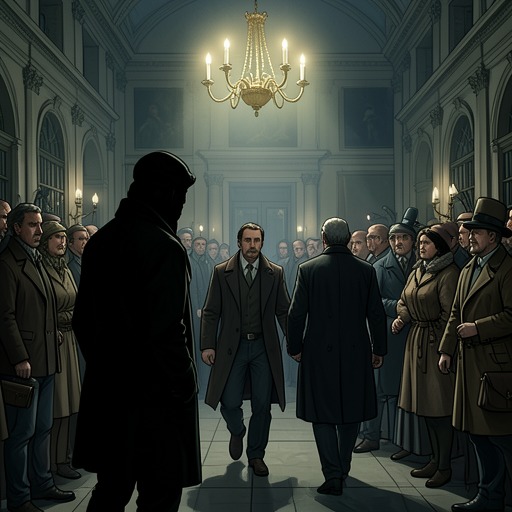
Goriladkin fled along the embankment of the Fontanka River in the rain, snow, and wind. He was ashamed and exhausted, staggering to a stop by the canal, feeling as though someone was nearby, although it seemed empty in the darkness
The following morning
The Double at the Office
Golyadkin awoke believing that the night before might have been just a dream, though his wet clothes, fatigue, and cold made it hard for him to deny the experiences. Although he wanted to stay at home, he went to the government office where he worked
Late morning on the second day
The Double’s Favorable Reception
Golyadkin inquired from Anton Antonovich about the appointment of a new employee, learning that the person was recommended and had left a good impression. The head clerk regarded this strange physical similarity as a curiosity rather than a threat. Golyadkin briefly told himself that there was no harm in
Afternoon on the second day
The Double’s Appeal
After work, the young Goliatkin actively approached the older himself, telling about poverty, the difficulties of being from the provinces, and the recent hardships. He said he came to St. [Petersburg](entity:location-recall-location-petersburg-2b56d8d0c312) with nothing, begging for protection, and described himself as timid, grateful, and willing to obey the host
Evening and night on the second day
A Night of Friendship
Two Goliad Jinbang had dinner, drank tea and punch, and talked for several hours. The young Goliad Jinbang told his misfortunes, wrote a four-line lyric poem, and won the trust of the elder; Goliad Jinbang expressed his resentment, and imagined that
Night on the second day
The Protest Letter
Goriladkin wrote a letter to the young Goriladkin, accusing him of forcibly entering his life, appropriating his documents and reputation, and humiliating him in public. He requested a written explanation and tried to make the complaint appear restrained, appropriate, and sufficient to withstand legal scrutiny
Late night on the second day
The Drunken Messenger
Golyadkin returns home exhausted and falls asleep before [Petrushka](entity:character-recall-character-petrushka-9509714a4ba3) comes back. In the night he wakes him and discovers that the servant is drunk and confused about the errand, though Petrushka eventually claims to have delivered the letter and obtained the address.
Petrushka speaks ominously of honest people having no doubles, then retreats to bed. Golyadkin fears that his servant has betrayed him, but a letter from [Vahramyev](entity:character-recall-character-vahramyev-3e624c84c7af) is waiting on the table, offering a first concrete account of how his private affairs have become entangled with gossip and the double’s new connections.
After midnight on the second day
Vahramyev’s Warning
[Vahramyev](entity:character-recall-character-vahramyev-3e624c84c7af)’s letter reports that the junior is lodging with [Karolina Ivanovna](entity:character-recall-character-karolina-ivanovna-e5ece04c8c65) and is associating with people who regard him favorably. It also accuses Golyadkin of damaging others’ reputations and ends their former friendship, while asking him to repay a small debt.
Golyadkin reads the letter as evidence of a widening plot. He composes an elaborate reply, defending his honor, offering to settle the debt, and denouncing anyone who tries to occupy another person’s place. His language makes explicit the principle that will govern his fear of the double: everyone, he insists, has a fixed position.
Morning on the third day
The Junior’s Disappearance
Golyadkin wakes to find the guest’s bed gone and no sign of the junior. [Petrushka](entity:character-recall-character-petrushka-9509714a4ba3) says that the other Golyadkin left earlier, using the phrase “the other one” as if the distinction were already familiar to everyone around him.
The senior debates how he might refuse the double hospitality if he returns, then hurries to the office to discover what is happening. His resolve to control the situation is already weakened by the possibility that the newcomer has left without answering his letter.
Morning on the third day
The Double Takes His Place
At the office, Golyadkin encounters the junior in the doorway. The newcomer brushes past him with a businesslike air and claims to be carrying out a special commission, making the senior’s effort to discuss their dispute seem irrelevant.
[Anton Antonovitch](entity:character-recall-character-anton-antonovitch-929b49ec8eaf) asks whether Golyadkin has finished copying the official document requested by [Andrey Filippovitch](entity:character-recall-character-andrey-filippovitch-0801e23e7100). Golyadkin tries to defend his conduct and explain himself, but his vague talk about masks and intrigue only irritates the head clerk, who tells him to stop making personal remarks.
Later that morning on the third day
The Stolen Document
As Golyadkin prepares the official document, the junior hovers beside him, pretends to notice a blot, and offers to remove it. In the brief confusion he takes the paper and carries it to [His Excellency](entity:character-recall-character-his-excellency-c1e074ff76a9)’s room, leaving the senior frozen with the penknife in his hand.
The work is praised as timely and well done, and the credit goes to the junior. When Golyadkin protests, [Andrey Filippovitch](entity:character-recall-character-andrey-filippovitch-0801e23e7100) refuses to hear what he calls a private matter. The double has turned the senior’s own labor into a means of advancement and humiliation.
Afternoon on the third day
Public Ridicule
Unable to confront his superiors, Golyadkin challenges the junior in front of the clerks. He accuses him of shamelessness, but the younger man answers with mock familiarity, pinches his cheek, pokes his stomach, and turns the exchange into a joke for the watching office.
The senior pursues him downstairs and catches him briefly, only for the junior to escape in a cab. Golyadkin is left exposed before the very colleagues whose approval he craves, and his sense of being deliberately displaced hardens into certainty.
Later on the third day
The Failed Appeal
Golyadkin returns to the department and questions Ostafyev, a copying clerk, about rumors and the junior’s position. He offers tips in exchange for information, but the clerk’s answers are vague and provide no reliable reassurance.
Golyadkin then sees the junior carrying a portfolio from [His Excellency](entity:character-recall-character-his-excellency-c1e074ff76a9) and again entering the office as if entrusted with important work. The senior’s attempts to gather information and seek allies bring only more suspicion; he is now watching his rival’s every movement while losing confidence in his own understanding.
Late afternoon on the third day
The Office’s Rejection
At the close of office hours, the junior charms the clerks, shaking hands and joking among them. By mistake he offers a hand to the senior, who accepts it in a rush of feeling; the junior then withdraws and wipes his fingers as though contaminated.
He calls Golyadkin a Russian Faublas, an allusion that the clerks understand and that leaves the senior publicly disgraced. Golyadkin tries to appeal to [Andrey Filippovitch](entity:character-recall-character-andrey-filippovitch-0801e23e7100), but his accusation of an impostor cannot compete with the junior’s easy acceptance among the officials.
Evening on the third day
The Second Letter
Golyadkin writes another letter, now demanding that the junior make way for him or face extreme measures. He carries it to the department, but cannot bring himself to enter and instead tries to learn what is happening through clerks.
When a messenger delivers a letter from [Vahramyev](entity:character-recall-character-vahramyev-3e624c84c7af), Golyadkin receives it but does not immediately understand its implications. His efforts to force the situation into formal correspondence are collapsing, while information reaches him in fragments that intensify rather than settle his fears.
Evening on the third day
The Pie Impersonation
At a restaurant, Golyadkin orders one pie and is told that he has eaten eleven. He is prepared to pay, unable to understand the discrepancy, until he sees the junior in a doorway he had mistaken for a mirror, finishing the last of the pies.
The senior concludes that the double has impersonated him and charged the meal to his account. Though he escapes without confronting the spectacle, the incident leaves him seething at the insult and fearing how easily the junior can make others accept a false version of events.
Evening on the third day
The Purported Letter
Back at the restaurant, Golyadkin reads a letter signed by [Klara Olsufyevna](entity:character-recall-character-klara-olsufyevna-f5af8a60018d). It claims that she is being forced into marriage, asks him to meet her with a carriage, and proposes that they flee together.
The letter rekindles his belief that he has been drawn into a dangerous intrigue. He notices that the diners are watching him and that his clothes are muddy and torn; when he reaches for a handkerchief, he finds the doctor’s medicine bottle instead. It falls and breaks, and Golyadkin interprets the episode as a sign that his life is in danger.
Night on the third day
Official Removal
An office attendant brings Golyadkin an official instruction, signed by [Andrey Filippovitch](entity:character-recall-character-andrey-filippovitch-0801e23e7100), to hand his work over to Ivan Semyonovitch. At home he finds [Petrushka](entity:character-recall-character-petrushka-9509714a4ba3) gathering his belongings, apparently preparing to leave for [Karolina Ivanovna](entity:character-recall-character-karolina-ivanovna-e5ece04c8c65)’s household.
Golyadkin’s employment and domestic life are both coming apart. He spends a nearly sleepless night in visions of the junior winning over everyone he meets and replacing him in the service and in society, until the imagined multiplication of doubles becomes a nightmare of total erasure.
The following afternoon
The Double’s Accusations
Golyadkin wakes at one o’clock to find [Petrushka](entity:character-recall-character-petrushka-9509714a4ba3) gone and his earlier letter missing. He assumes the servant has been bribed and that a hostile plan has advanced while he slept.
He goes out and catches up with the junior, who refuses to hear him and insists that the senior has behaved strangely. The two eventually enter a coffeehouse, where the junior orders chocolate and a tart, then taunts Golyadkin with insinuations about [Karolina Ivanovna](entity:character-recall-character-karolina-ivanovna-e5ece04c8c65) and the old rumors. The meeting that might have produced an explanation becomes another public humiliation.
Later that afternoon
The Reconciliation That Fails
Golyadkin insists that he has never been the junior’s enemy and tries to restore their former friendliness. He admits that his protest letter was mistaken, asks the other man to reinterpret it as friendly, and even accepts the possibility that nature has created two identical people.
The junior appears to accept the apology, but turns the encounter into a performance of dominance. He repeats his humiliating gestures, leaves without paying for the food, and escapes in a cab. Golyadkin follows, clinging to the vehicle until he is thrown into the mud near [Olsufy Ivanovitch](entity:character-recall-character-olsufy-ivanovitch-0b1b29654efe)’s house.
Evening on the fourth day
The Flight Plan
Back at his flat, Golyadkin finds [Petrushka](entity:character-recall-character-petrushka-9509714a4ba3) again and tries to part from him with a character reference and a final request for help. Petrushka speaks of a rival and an elopement, while Golyadkin clings to the purported letter from Klara and asks the servant to prepare clothes, bedding, and a carriage.
The plan is confused and contradictory: Golyadkin alternates between imagining flight with Klara, seeking protection from his superiors, and condemning the very idea of elopement. He leaves the flat alone before Petrushka can return with the promised preparations.
Evening on the fourth day
The Plea to His Excellency
Golyadkin hires a cab and goes to [His Excellency](entity:character-recall-character-his-excellency-c1e074ff76a9)’s residence, rehearsing an appeal in which he will surrender himself to his superior’s protection and insist that he is not the other Golyadkin. His argument shifts between submission and accusations against the supposed impostor.
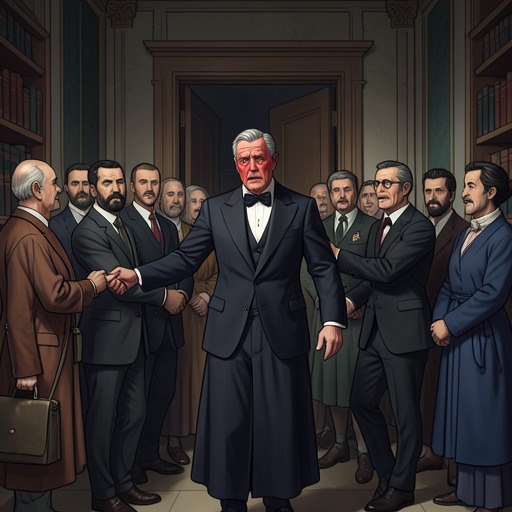
When he is admitted, he struggles to explain himself before His Excellency and several officials. The junior is present, and Golyadkin finally calls him vicious and false. His Excellency rings for assistance; the visitors and servants guide the senior out, while the junior follows with mocking farewell. Golyadkin’s last appeal to official authority has ended in expulsion.
Later that evening on the fourth day
The Vigil at the House
Golyadkin returns to [Olsufy Ivanovitch](entity:character-recall-character-olsufy-ivanovitch-0b1b29654efe)’s house and waits in the yard by a stack of firewood, believing that Klara may signal him to flee. He is soaked, feverish, and unsure whether the party is taking place on the night named in the letter.
He loses the letter and fears that the junior has taken it as evidence against him. As he waits, he rehearses arguments about morality, marriage, and the propriety of carrying off a young woman, exposing the contradiction between the romantic flight he has imagined and the social rules he claims to defend.
Late evening on the fourth day
The Invitation Inside
People appear at the windows and call to Golyadkin from the house. The junior comes into the yard, urges him inside, and leads him through the crowd despite his weak protest that he would rather go home.
In the drawing room, the guests gather around him and conduct him toward [Olsufy Ivanovitch](entity:character-recall-character-olsufy-ivanovitch-0b1b29654efe), with [Klara Olsufyevna](entity:character-recall-character-klara-olsufyevna-f5af8a60018d), [Vladimir Semyonovitch](entity:character-recall-character-vladimir-semyonovit-047fc4034b3f), and [Andrey Filippovitch](entity:character-recall-character-andrey-filippovitch-0801e23e7100) nearby. Golyadkin interprets the attention as sympathy and reconciliation, even though he cannot know what the ceremony means.
Near midnight on the fourth day
The False Reconciliation
The assembled guests seat Golyadkin before [Olsufy Ivanovitch](entity:character-recall-character-olsufy-ivanovitch-0b1b29654efe) and arrange the two Golyadkins opposite one another. A solemn silence and the crowd’s expectant attention make the senior imagine that his grievance will be settled and the pair reconciled.
At the prompting of the company, the two men are brought together and kiss. Golyadkin glimpses a sly wink and a grimace on the junior’s face, then sees an endless multitude of identical doubles filling the room. The supposed reconciliation becomes the final triumph of the image that has overwhelmed his grasp of reality.
Moments after the false reconciliation
The Doctor’s Arrival
A door opens and [Krestyan Ivanovitch Rutenspitz](entity:character-recall-character-krestyan-ivanovitch-64ee0abd4b7f) enters, recognizable to Golyadkin as the doctor he has consulted before. The doctor takes his hand and draws him away while the junior eagerly leads the way with a candle.
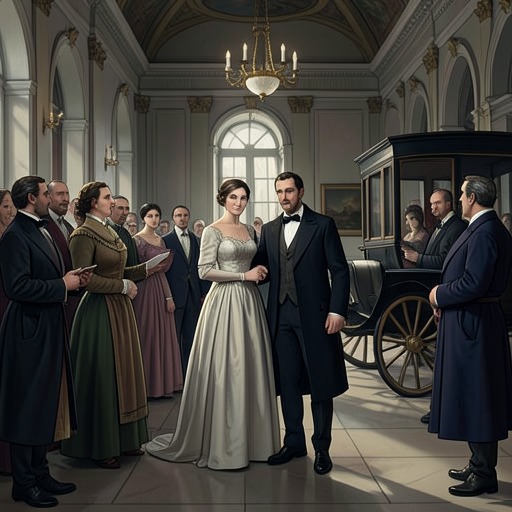
The party follows and repeats that the doctor is an old friend. Golyadkin, overwhelmed and reduced to asking whether he has done anything reprehensible, is helped into a carriage by Krestyan Ivanovitch and [Andrey Filippovitch](entity:character-recall-character-andrey-filippovitch-0801e23e7100) as the crowd watches. The junior runs alongside, laughing and throwing farewell kisses, while the carriage carries Golyadkin away toward an unknown destination.
Near the ending
The Final Journey
Golyadkin regains consciousness in the carriage on a deserted road bordered by dark woods. The man beside him resembles Krestyan Ivanovitch but seems transformed into a terrible, punitive figure.
The doctor declares that Golyadkin will receive free quarters, wood, light, and service, which he says the patient does not deserve. Golyadkin cries out and clutches his head as the journey continues, ending the novel in forced removal and the collapse of his remaining defenses.